
The “Boomer Era” was a unique time in history for kids growing up, but maybe a little more unique for those growing up in Miramar Park. Miramar had amenities abound, a unique geography and location, with a spatial arrangement of homes that made it a haven for play.
Miramar is a secluded close-knit subdivision built on a heavily wooded hillside nestled in on the north shore of Potter’s Lake lying between Pine St. and Walnut St. (east to west), and between Miramar Rd. and Miramar Drive (north to south). Traversed through the center by White Oak Street. All roads within the Park are named after the native trees. Miramar Park encompasses approximately eighty acres of land with 450 potential homesites and has 3 easements: the Boat Dock #1, Sandy Beach #2, Elm St. #3.
The easements alone were enough for kids to play, but add the nature of Miramar, the Little Green Store, Sokol Camp, Heath’s Resort, and Brophy’s Horses. Boredom was impossible. Miramar Park was a self-contained playground for kids. The ideal place to grow up!
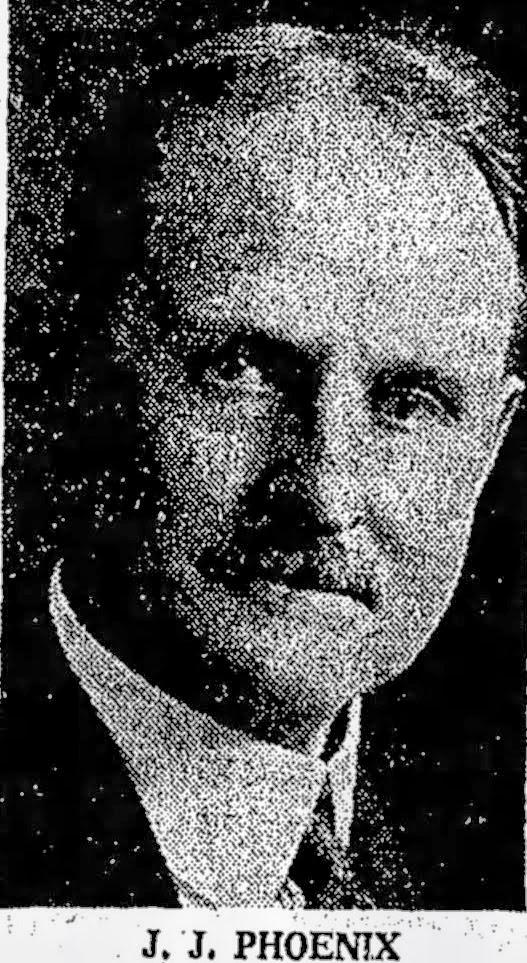
Miramar Park was formed in 1926 by John Jay Phoenix. Phoenix purchased the land from Henry C. Kuenzli, who in turn purchased it from the Potter estate. Intuition leads me to believe Miramar Park was merely an investment opportunity for Mr. Phoenix, for he was an entrepreneurial businessman from Delavan who owned a knitting company. He was financially secure. J. J. Phoenix was a civic leader in his community. He was instrumental with incorporating an electric light company in Delavan, helped form a Christian Science denomination, was an active member of the Knights of Pythias fraternity, and was an honorary member of the Rotary club. Side note: His grandfather, Samuel F. Phoenix (1798-1840), founded Delavan in 1836 as a temperance colony, and was also instrumental in naming our county “Walworth.”
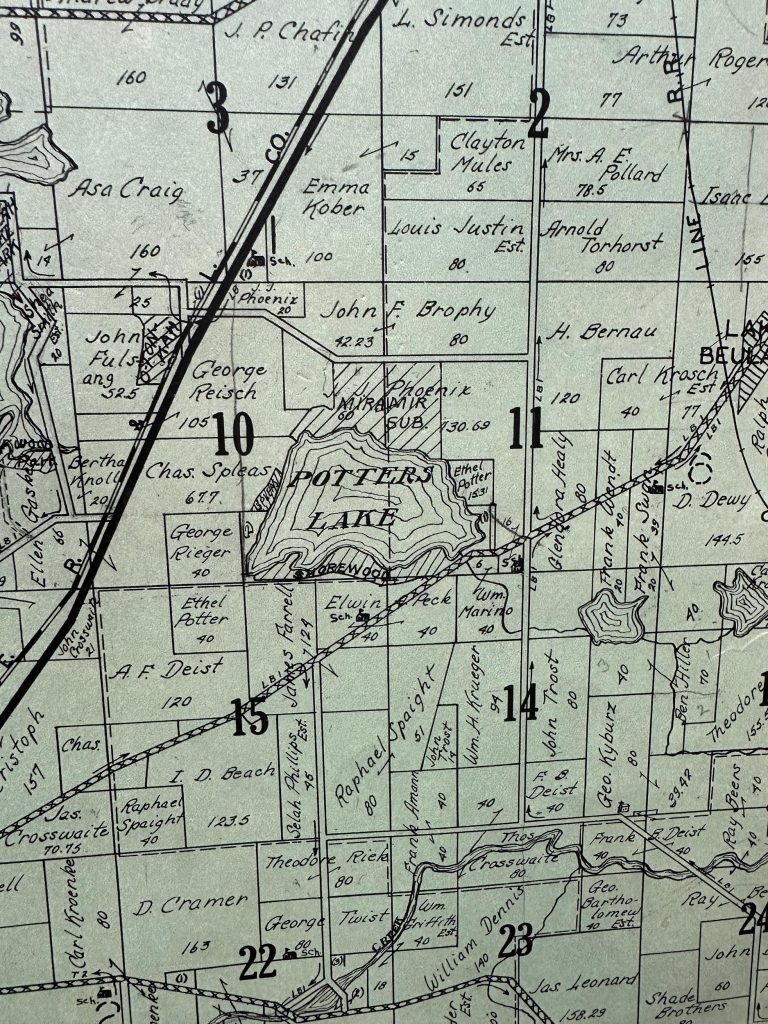
The word Miramar is derived from Spanish/Portuguese, meaning: “view of the sea.”
Miramar’s inception was a time in history referred to as the “cottage years.” A time when people had little disposable income due to the stock market crash of 1929 causing the Great Depression. People were forced to be frugal. Miramar was an affordable place for the struggling “working man” to seek respite or even make a home.
Miramar Park was a blue collar “working man’s” neighborhood. It offered homesites for lower-middle class Americans. It was during the post war years of WW2 and Korea when the economy shifted and families were on the rise that Miramar Park began to flourish with permanent dwellings. Many sizable families of the same vintage grew up together in close proximity. There was no trouble finding someone to play with. Whether you were a riparian landowner on Potter’s Lake or a lot owner in the backdrop, you and your neighbors were “cut from the same cloth,” comrades-in-arms you might say, all on the level.

A sign of the times? J.J. Phoenix had restrictions on who could buy or occupy property in Miramar Park. Here is an excerpt from a 1933 land contract with Duncan Major:
“No Negro, Mulatto, Chinese, Japanese, or person of any race or mixture of races, other than a person of pure white race, shall acquire title to any lot or building in this subdivision, or acquire the right to occupy such lot or building, or any part of a building, as owner, tenant, roomer, or otherwise, on or before January 1, 1960, except that the white owner or white tenant of any lot or lots, or residential building theron, may permit his domestic servant or servants, not of the pure white race, to occupy a room or rooms in his said residence, or garage building, during the period of such domestic service.”
In 1941 J. J. Phoenix formed a corporation, in essence, he deeded his property to the Miramar Park Property Association. It was to ensure the wellbeing of its property owners, and for maintaining the three deeded easements. I’m sure he considered personal liability protection.
Miramar Boys
“Miramar Boys” was the fabrication of an imaginary club having an unwritten origin and an unwritten membership. You were a member because you lived in Miramar. I was a “Miramar Boy,”

Miramar boys were thought of as mischievous rogue children by outsiders. They were the “Little Rascals” of East Troy. It is true, we had our ruffians, for we were exposed to a lot of adult behaviors at a young age. We grew up fast and hard. From the innocent to the delinquent, growing up in Miramar had its challenges. More than not, activities were wholesome and fun, we just played a little rougher than others.There was a Darwinian hierarchy among us boys. “Might is right” and the bully wins. Age and size dictated who was boss, and if you were out of line, you were paid in kind by the jury of your peers.’ It was a “rite of passage” for the young, but they knew their day would come.
To this day, whenever and wherever we may meet, we smile with a smirk and give a firm handshake. There is a mystique about being a Miramar Boy, for there is an inherent camaraderie between us. We are proud and grateful for growing up in Miramar.
Sandy Beach
Sandy Beach was the community swimming hole. A place where all residents of Miramar could come and play, young and old alike. It was located between Maple Street and Hickory. The terrain starts out flat then becomes a hillside to the lake.

Sandy Beach was by far the most popular and most used because it was the swimming hole. You could say, it was “where the action is!” Kids from all over the Park came to play. From rag-tag to king-of-raft, making people towers, or seeing how far you could swim under water, not to mention looking for that pretty someone. Sandy Beach was the place to be.
No life guard or supervision, you swam at your own risk. Big kids ruled the roost. Pretty girls were always welcome.

Potter’s Lake was nothing special, it was weedy and mucky, but as kids, we could care less. To us it was a playground made of water. Outsiders called it Potter’s Puddle, but we could care less what they thought. If you could swim in Potter’s you could swim in any lake, and we did without question. We had fun!
We had a blast playing “rag-tag” out at the raft. The raft was made of wood utilizing nine 55 gallon drums set in three rows of three with space in between, ideal to duck and hide. It wasn’t easy if you were “it.”
Swim all day till you could only see fog.
Sokol Camp

Sokol (Gymnastics) Camp was formed circa 1950 by Jerry Fontana and Mike Jacki, both were world class gymnasts. Sokol Camp was situated on the old John Potter estate in the NE corner of Miramar. It was utilized by Slovaks and gymnasts alike. Activity was intermittent in the ‘60s and ‘70s.
Because Sokol was quiet most of the time, we “Miramar rogues” would utilize their facility, namely the baseball field. Pickup-ball was easy to come by. Lots of kids to choose from. Guys would ride their bicycles up and down the streets shouting the time and place. Then it happened. Typical sandlot ball, the older and stronger kids were the captains and chose their team. The captain with the first pick, would relinquish the next two picks, then they alternated subsequently. Young or old, everyone participated. Some had gloves, and others did not.
Welcome to Miramar.
The Little Green Store
It is impossible to think that whoever grew up in Miramar Park could ever forget Lakeview Grocery aka “The Little Green Store.” The coined name sounds like it came out of a 19th century fairytale. The Little Green Store was our convenience store. It had the basics for a meal, comfort food, penny candy, trinkets, and of course, beer and cigarettes too. It was our “Big Rock Candy Mountain.”
The Little Green Store was owned early on by Hitzman ‘50s, then Madlung ‘60s, and finally Ramlows during the ‘70s before its dissolution. It was located on Miramar Road on the East (central ) end of Potter’s Lake. For us kids, it was fun to walk to the store and scour the ditches for soda bottles. Each bottle was worth a couple of cents, and by the time you got to the store, you’d have enough money to buy some penny candy.
Schmidt’s / Heath’s Resort
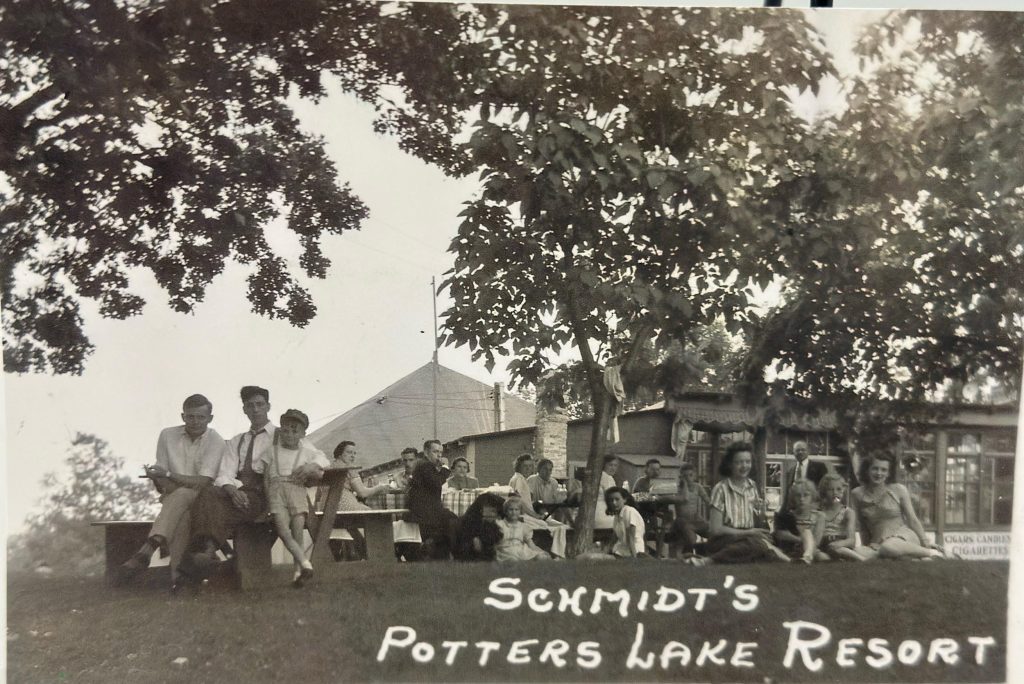
Heath’s and Schmidt’s resort were one and the same, just different time periods. Schmidt’s were the originators that created the resort in the late 1920s. It was located on the SE corner of Potter’s Lake, close to Hwy L near the public boat launch.
Mrs. Hermann Schmidt was the proprietress and valued the importance of her visitors being well taken care of.
She had cozy little cottages and boats for rent, a nice picnic area with shade trees, and a landscape that gently led to the lake with a firm bottom swimming beach. Musical bands performed on the weekends so customers could kick up their heels on her ballroom floor. On Sundays she’d offer a nice dinner. Mrs. Schmidt had the knowledge and wherewithal to be good at what she did. People came from all around, not just locals. People from Milwaukee and Racine were common. It was a getaway for the whole family.
Ray Heath lived off the laurels of the Schmidt’s, and ran the resort in the late ‘50s into the ‘70s before the doors closed forever. Now it is filled with homesites. Only a memory. “Those were the days.”
Brophy’s Farm

During the 1950s and ‘60s was a time when Matt and Shorty Brophy allowed the public to come and ride horses. You paid their fee and you were sent off on your own. There was no guide, you rode at your own risk.
Brophy’s farm was located just outside of Miramar Park, it was the first farm on the left heading north from the t-intersection of Miramar
Road and Stone School Road. The area now known as Harmony Lane subdivision was always referred to as “Brophy’s Field.”
The Boomer Era was a special time in history for those growing up in Miramar Park. The spirit of freedom was woven through from one end of the Park to the other. It was the admixture of places, moments, people and interactions, both physical and mental that made Miramar so special. If we could go back in time, we wouldn’t change a thing.
“Those were the days my friend, we thought they’d never end.” Thank you, Miramar!


